30.09.2026
Most Strategic Plans Are Just Wish Lists in a Nicer Font
Imagine the scene: a family sits down on New Year's Eve to write their resolutions.
"Get rich." "Get fit." "Travel more." "Be happy."
They frame it, stick it on the fridge, and never look at it again.
Harmless, right? A bit of hope on paper.
Now take that exact same list. Print it on heavier stock. Add four letters — O, G, S, M — a couple of KPIs, and a slide with the company logo in the corner.
Congratulations. It's a strategy now.
Except it isn't.
"Get rich." "Get fit." "Travel more." "Be happy."
They frame it, stick it on the fridge, and never look at it again.
Harmless, right? A bit of hope on paper.
Now take that exact same list. Print it on heavier stock. Add four letters — O, G, S, M — a couple of KPIs, and a slide with the company logo in the corner.
Congratulations. It's a strategy now.
Except it isn't.
A wishlist doesn't become a strategy because you formatted it better.
I've spent a good part of my career in the gap between what companies say they'll do and what actually gets built. And if there's one thing I've learned watching planning cycles across very different industries and geographies, it's this: most "strategic plans" aren't strategies at all. They're aspirations with better formatting.
Let me explain why — and what to do about it.
What Most Boardrooms Still Miss
Richard Rumelt made the point probably better than anyone in Good Strategy / Bad Strategy: a strategy is not a goal. It's not a vision. It's not the number you want to hit by 2027.
A strategy is a coherent response to a defining challenge.
He breaks it into what he calls the kernel — three parts, in order:
Notice the order. Diagnosis comes first. Everything else is downstream of it.
Now look at how most organizations actually plan. They open the template. They start typing objectives. They pick a few ambitious numbers. They list initiatives that sound strategic.
They start at step two and quietly pretend step one already happened.
That's not strategy. That's decorating.
A strategy is a coherent response to a defining challenge.
He breaks it into what he calls the kernel — three parts, in order:
- A diagnosis of what's actually going on.
- A guiding policy for how you'll deal with it.
- A set of coherent actions that deliver on that policy.
Notice the order. Diagnosis comes first. Everything else is downstream of it.
Now look at how most organizations actually plan. They open the template. They start typing objectives. They pick a few ambitious numbers. They list initiatives that sound strategic.
They start at step two and quietly pretend step one already happened.
That's not strategy. That's decorating.
OGSM Is a Good Tool. That's Exactly Why It's Dangerous.
Let me be precise here, because I'm not here to bash OGSM. I use it. Done right, it's one of the cleanest planning tools there is — Objectives, Goals, Strategies, Measures, all on a single page, forcing a cascade from ambition down to what you'll actually track.
But a tool is only as honest as the thinking you feed it.
Point an OGSM at a real diagnosis and it becomes a bridge. Point it at wishful thinking and it becomes a very tidy way to lie to yourself:
→ The Objective becomes an aspiration nobody's pressure-tested → The Goals become numbers someone in finance wanted → The Strategies become a list of things that sound strategic → The Measures become a dashboard tracking motion, not progress
Same template. Opposite outcome. The difference is entirely upstream.
And the data on what happens when you skip the upstream work is brutal.
But a tool is only as honest as the thinking you feed it.
Point an OGSM at a real diagnosis and it becomes a bridge. Point it at wishful thinking and it becomes a very tidy way to lie to yourself:
→ The Objective becomes an aspiration nobody's pressure-tested → The Goals become numbers someone in finance wanted → The Strategies become a list of things that sound strategic → The Measures become a dashboard tracking motion, not progress
Same template. Opposite outcome. The difference is entirely upstream.
And the data on what happens when you skip the upstream work is brutal.
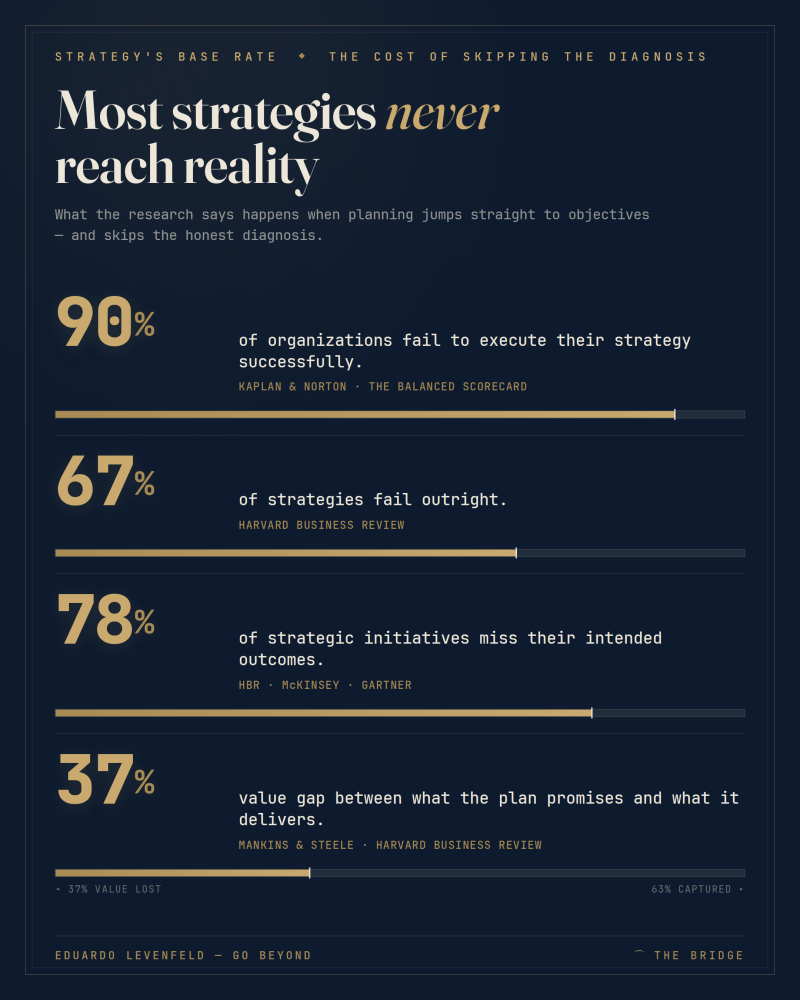
Kaplan and Norton, the people behind the Balanced Scorecard, put it at 90% of organizations failing to execute their strategies successfully. Harvard Business Review pegs strategy failure at around 67%. Pull the HBR, McKinsey and Gartner research together and the figure climbs as high as 78% of strategic initiatives failing to achieve their intended outcomes. And the classic Mankins & Steele work in HBR found companies capture only about two-thirds of their strategy's potential value — a 37% gap between what the plan promised and what it delivered.
Read that twice. This isn't a rounding error. It's the base rate.
But here's the stat that actually explains why.
Read that twice. This isn't a rounding error. It's the base rate.
But here's the stat that actually explains why.
Nobody Can Even Name the Strategy
Donald Sull and his team at MIT Sloan ran the test almost no one dares to run. They asked managers to simply list their own company's top strategic priorities.
Given five tries, fewer than one in three could name three of them.
Let that land. Not customers. Not junior staff. The people responsible for executing the strategy couldn't recite it.
And when Sull's team analyzed how large public companies actually wrote their priorities, only about 6% included a quantitative target. The rest were vague enough that, in his words, you often couldn't even guess the company — or the industry — from reading them.
Given five tries, fewer than one in three could name three of them.
Let that land. Not customers. Not junior staff. The people responsible for executing the strategy couldn't recite it.
And when Sull's team analyzed how large public companies actually wrote their priorities, only about 6% included a quantitative target. The rest were vague enough that, in his words, you often couldn't even guess the company — or the industry — from reading them.
If everyone in the room nods instantly, you haven't set a priority. You've written a horoscope.
Sull says it plainly: when it comes to real priorities, the absence of conflict is usually a sign of failure, not health. A genuine strategy creates winners and losers inside your own portfolio. A wishlist offends no one — which is exactly the problem.
This is the floating-wishlist disease. And efficiency doesn't cure it. Regular readers know I've argued that AI won't fix your projects because it works on the symptom layer — execution — while the real failure lives at the decision layer. Same logic, one level up. AI will now generate you a beautiful, fluent, perfectly formatted OGSM in about thirty seconds. Which means producing strategy-shaped text has never been cheaper — and producing actual strategy has never been more valuable by contrast.
The tools got faster at writing the wishlist. They didn't get any better at doing the diagnosis.
This is the floating-wishlist disease. And efficiency doesn't cure it. Regular readers know I've argued that AI won't fix your projects because it works on the symptom layer — execution — while the real failure lives at the decision layer. Same logic, one level up. AI will now generate you a beautiful, fluent, perfectly formatted OGSM in about thirty seconds. Which means producing strategy-shaped text has never been cheaper — and producing actual strategy has never been more valuable by contrast.
The tools got faster at writing the wishlist. They didn't get any better at doing the diagnosis.
The Fix: Diagnosis → OGSM → Coherent Actions → Deliver
So how do you anchor the thing to reality? Four steps, in order. The order is the whole point.
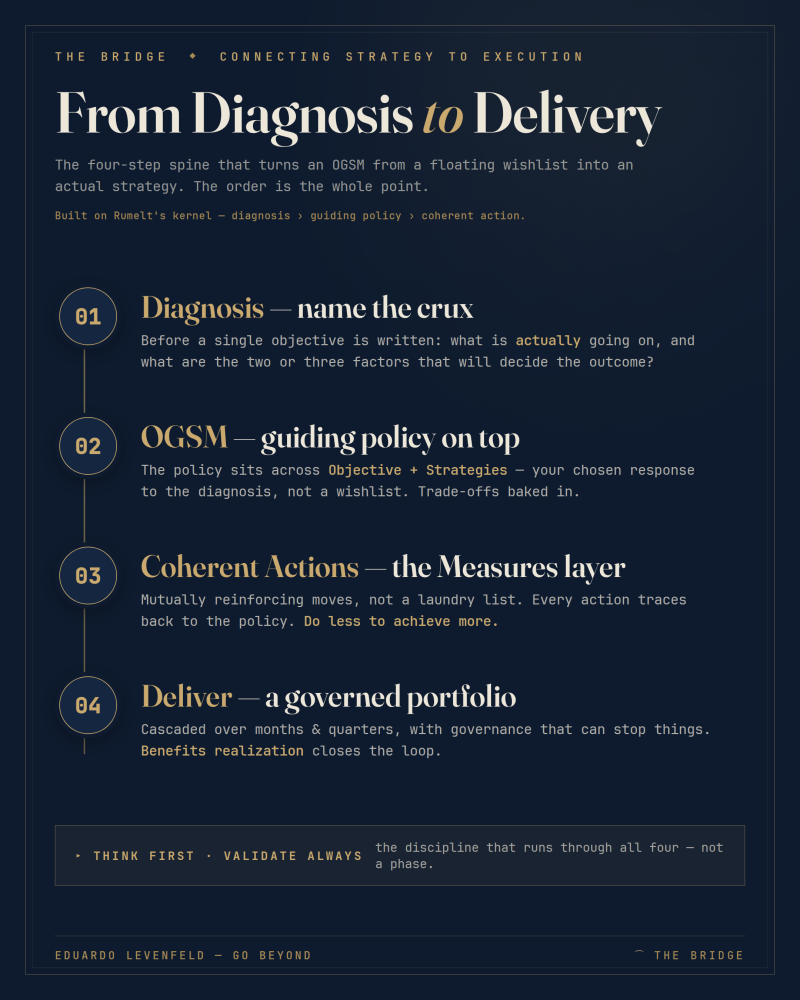
1. Diagnosis first — name the crux out loud
Before a single objective gets written, do the unglamorous work Rumelt insists on: assess the situation honestly. What's actually going on? What are the two or three factors that will genuinely decide the outcome? What's in the way that everyone keeps politely not mentioning?
This is the hardest step, which is exactly why it gets skipped. A real diagnosis forces you to say what's broken, name the constraint you can't wish away, and admit which battles you're choosing not to fight.
I've sat in planning rooms where the "strategy" ran to forty initiatives and not one sentence describing the actual problem the company was facing. Everyone could tell you what they wanted to do. Nobody could tell you what was wrong. That's a portfolio built on a napkin — and I've watched exactly that turn into wasted quarters, frustrated teams, and launches nobody needed.
No diagnosis, no strategy. Full stop.
This is the hardest step, which is exactly why it gets skipped. A real diagnosis forces you to say what's broken, name the constraint you can't wish away, and admit which battles you're choosing not to fight.
I've sat in planning rooms where the "strategy" ran to forty initiatives and not one sentence describing the actual problem the company was facing. Everyone could tell you what they wanted to do. Nobody could tell you what was wrong. That's a portfolio built on a napkin — and I've watched exactly that turn into wasted quarters, frustrated teams, and launches nobody needed.
No diagnosis, no strategy. Full stop.
2. OGSM as the vehicle — put the guiding policy on top
Now, and only now, open the template. Now comes your guiding policy — how you'll deal with the crux — and it should sit across the Objective and the Strategies.
That single move changes everything. The Objective stops being an aspiration and becomes your chosen response to the diagnosis. The Strategies stop being a wishlist of "things we could do" and become the coordinated bets that follow directly from that response. The trade-offs are baked in from the start, not bolted on later.
If your Objective and Strategies could belong to any company in your sector, go back to step one. You skipped the diagnosis.
That single move changes everything. The Objective stops being an aspiration and becomes your chosen response to the diagnosis. The Strategies stop being a wishlist of "things we could do" and become the coordinated bets that follow directly from that response. The trade-offs are baked in from the start, not bolted on later.
If your Objective and Strategies could belong to any company in your sector, go back to step one. You skipped the diagnosis.
3. Coherent Actions become the Measures/Actions layer
Rumelt's third element — coherent, coordinated action — becomes the M in your OGSM. And coherent is the operative word. Not a laundry list of parallel initiatives all fighting for the same people and budget. A set of moves that reinforce each other, each one pulling in the direction the guiding policy points.
This is where "doing less to achieve more" stops being a slogan and becomes a filter. Every action either serves the guiding policy or it doesn't. The ones that don't — the pet projects, the zombie initiatives, the things there to make someone's quarter look busy — get killed, not cascaded.
If an action doesn't trace cleanly back to the diagnosis, it isn't coherent. It's just activity wearing a project charter.
This is where "doing less to achieve more" stops being a slogan and becomes a filter. Every action either serves the guiding policy or it doesn't. The ones that don't — the pet projects, the zombie initiatives, the things there to make someone's quarter look busy — get killed, not cascaded.
If an action doesn't trace cleanly back to the diagnosis, it isn't coherent. It's just activity wearing a project charter.
4. Deliver — a governed portfolio, run over months and quarters
Strategy that stops at the slide is the whole problem we started with. So the final step is delivery discipline: the guiding policy and coherent actions cascade into a real portfolio, with real governance, run over the horizon it actually takes — months and quarters, not a single offsite.
That means portfolio reviews that ask "are the benefits still there?" instead of only "are we on time and on budget?" It means measuring whether the value you promised actually showed up — six, twelve, eighteen months after delivery — and feeding that honesty back into the next cycle's diagnosis. It means governance with the spine to stop things, not just to start them.
This is the layer where most strategies quietly die of neglect. The plan gets approved, everyone claps, and eighteen months later nobody checks whether it worked. Benefits realization isn't a reporting chore. It's the loop that keeps the whole thing honest.
That means portfolio reviews that ask "are the benefits still there?" instead of only "are we on time and on budget?" It means measuring whether the value you promised actually showed up — six, twelve, eighteen months after delivery — and feeding that honesty back into the next cycle's diagnosis. It means governance with the spine to stop things, not just to start them.
This is the layer where most strategies quietly die of neglect. The plan gets approved, everyone claps, and eighteen months later nobody checks whether it worked. Benefits realization isn't a reporting chore. It's the loop that keeps the whole thing honest.
The Discipline That Runs Through All Four
One more thing, because it sits across every step rather than inside any of them.
None of this survives contact with a copy-paste prompt. The entire point of a diagnosis is that a human did the thinking — sat with the ambiguity, argued the trade-offs, named the uncomfortable thing. Bring AI in to pressure-test your diagnosis, sharpen your guiding policy, stress-test your portfolio, absolutely. But bring it in to validate and extend your thinking — not to replace it.
Think first. Validate always. In that order. Because a machine will happily hand you a confident, well-structured strategy for a situation it never actually diagnosed — and that's just the wishlist problem again, arriving faster and dressed better.
None of this survives contact with a copy-paste prompt. The entire point of a diagnosis is that a human did the thinking — sat with the ambiguity, argued the trade-offs, named the uncomfortable thing. Bring AI in to pressure-test your diagnosis, sharpen your guiding policy, stress-test your portfolio, absolutely. But bring it in to validate and extend your thinking — not to replace it.
Think first. Validate always. In that order. Because a machine will happily hand you a confident, well-structured strategy for a situation it never actually diagnosed — and that's just the wishlist problem again, arriving faster and dressed better.
The Uncomfortable Part
Here's the part nobody likes to say out loud.
Writing the wishlist is the fun part. It's optimistic, it's collaborative, it photographs well on the boardroom wall. The diagnosis is the opposite — it's uncomfortable, it creates conflict, it forces someone to be wrong in a room full of their peers.
So we skip it. We jump to objectives because objectives feel like progress. And then we act surprised when 70, 78, 90 percent of the time, the beautiful plan doesn't survive contact with reality.
Before your next planning cycle, resist the urge to open the template. Don't start with "what do we want to achieve?" Start with the harder question:
What is actually going on here, and what's the one thing that will decide whether we win?
Answer that honestly, and the OGSM almost writes itself. Skip it, and no font in the world will save you.
Writing the wishlist is the fun part. It's optimistic, it's collaborative, it photographs well on the boardroom wall. The diagnosis is the opposite — it's uncomfortable, it creates conflict, it forces someone to be wrong in a room full of their peers.
So we skip it. We jump to objectives because objectives feel like progress. And then we act surprised when 70, 78, 90 percent of the time, the beautiful plan doesn't survive contact with reality.
Before your next planning cycle, resist the urge to open the template. Don't start with "what do we want to achieve?" Start with the harder question:
What is actually going on here, and what's the one thing that will decide whether we win?
Answer that honestly, and the OGSM almost writes itself. Skip it, and no font in the world will save you.
Sources & Further Reading
- Richard Rumelt — Good Strategy / Bad Strategy (2011)
- Robert Kaplan & David Norton — The Balanced Scorecard
- Donald Sull, Rebecca Homkes, Charles Sull, Stefano Turconi & James Yoder — MIT Sloan Management Review, "Turning Strategy Into Results" and the Strategic Agility Project
- Michael Mankins & Richard Steele — "Turning Great Strategy Into Great Performance," Harvard Business Review
- Harvard Business Review, McKinsey & Gartner — research on strategy-execution failure rates
- PMI — Pulse of the Profession (2025)
Subscribe to The Bridge Newsletter
#TheBridge #Strategy #Transformation #OGSM #Leadership