30.09.2026
The Product Development Life Cycle Is a Loop, Not a Line
Most explanations and ideas within people's mind of the Product Development Life Cycle is drawn as a straight line: idea on the left, launch on the right, an arrow in between. It's tidy. It's also the single most expensive misconception in product work.
Because the line implies a finish. And when a team believes launch is the finish, they under-invest in the two things that decide whether a product lives:
The line quietly turns a continuous system into a one-way march — and the numbers show what that march costs.
The famous figure comes from Harvard's Clayton Christensen: of the roughly 30,000 products introduced each year, the vast majority fail. Newer research argues the honest number is closer to 40% than 90% — but the direction never changes. The dominant cause of failure isn't bad engineering. It's building something real people never actually wanted.
So let's redraw the map. Not as a line with an end, but as a loop that keeps feeding itself.
Because the line implies a finish. And when a team believes launch is the finish, they under-invest in the two things that decide whether a product lives:
- Understanding the problem before they build.
- Learning from reality after they ship.
The line quietly turns a continuous system into a one-way march — and the numbers show what that march costs.
The famous figure comes from Harvard's Clayton Christensen: of the roughly 30,000 products introduced each year, the vast majority fail. Newer research argues the honest number is closer to 40% than 90% — but the direction never changes. The dominant cause of failure isn't bad engineering. It's building something real people never actually wanted.
So let's redraw the map. Not as a line with an end, but as a loop that keeps feeding itself.
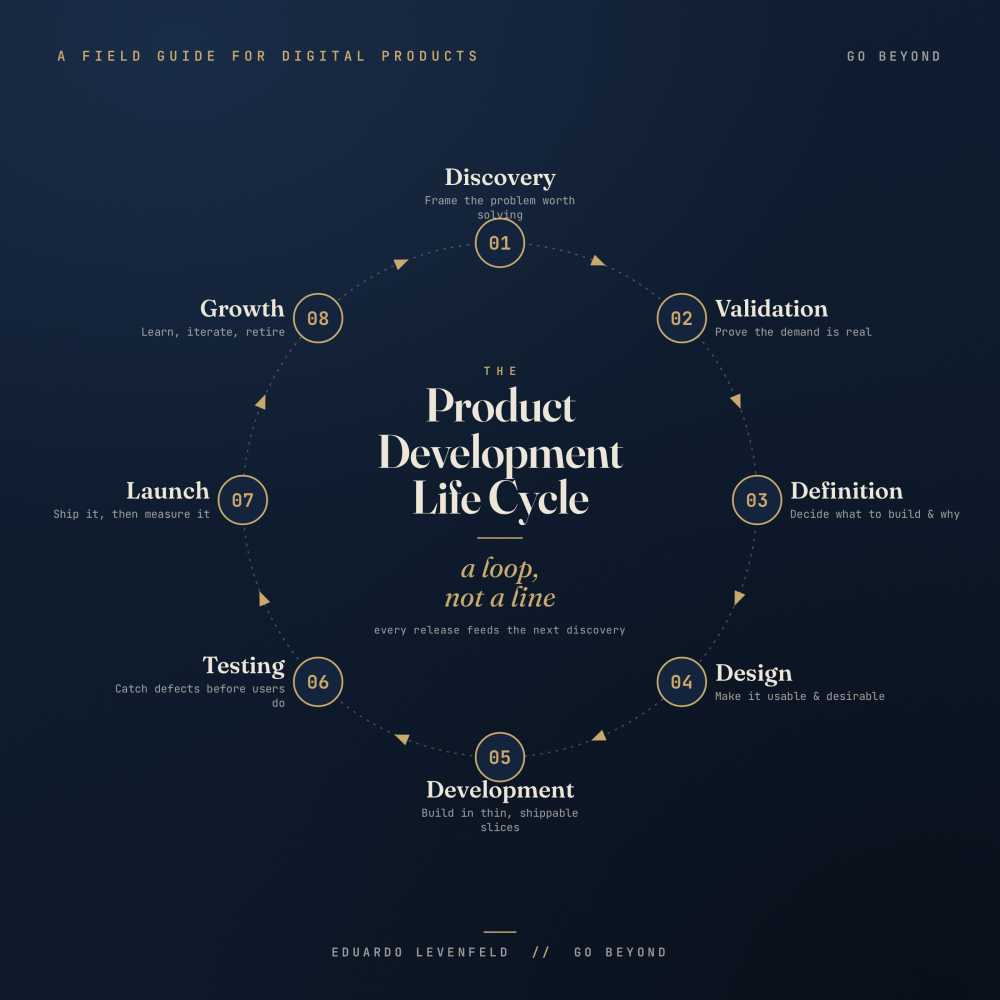
Eight stages. Each one asks a specific question. Each one has frameworks that sharpen the question and tools that help you answer it. And crucially — the last stage flows straight back into the first.
01 · Discovery — Frame the problem worth solving
Before a single screen gets designed, the job is to find a problem real enough that people will change their behaviour to solve it.
Most products start to die from this point, in disguise: the team assumes the problem, skips the evidence, and spends nine months building a confident answer to a question nobody asked.
Discovery replaces assumptions with evidence — about who hurts, how badly, and why the alternatives they use today fall short.
Universal example: for a generic productivity app, discovery isn't "people want to be more organized." It's pinpointing the exact moment of friction where they currently give up — because that moment is the whole product.
- Frameworks: Jobs-to-be-Done (what progress is the user "hiring" the product to make?), Design Thinking, the Lean Canvas to map the whole business on one page.
- Tools: Miro for mapping, Dovetail for research synthesis, structured user interviews, Maze.
Universal example: for a generic productivity app, discovery isn't "people want to be more organized." It's pinpointing the exact moment of friction where they currently give up — because that moment is the whole product.
02 · Validation — Prove the demand is real
Discovery tells you a problem might exist. Validation tells you whether anyone will actually sign up, switch, or pay. This is the stage the failure statistic punishes hardest, and it's also the cheapest insurance you'll ever buy: a landing page, a fake-door test, a concierge MVP, ten honest conversations before you write production code.
The goal isn't to confirm you're right. It's to find the fastest, cheapest way to discover you're wrong.
Universal example: a smart sign-up page that measures real intent — clicks, emails, pre-orders — before engineering touches anything.
The goal isn't to confirm you're right. It's to find the fastest, cheapest way to discover you're wrong.
- Frameworks: Lean Startup (build–measure–learn, the MVP), the Design Sprint, riskiest-assumption tests.
- Tools: Figma clickable prototypes, Typeform, Mixpanel, UserTesting.
Universal example: a smart sign-up page that measures real intent — clicks, emails, pre-orders — before engineering touches anything.
03 · Definition — Decide what to build, and why
Now that the problem is real and wanted, definition sets scope, sequence and success metrics. It looks like a planning problem; it's really a prioritization problem. The output is a roadmap and requirements — but the actual deliverable is a defensible answer to "why this, why now, and why not the other twenty things on the list?"
Universal example: cutting v1 down to the single workflow that proves the value — and having the nerve to defer everything else.
- Frameworks: RICE and MoSCoW for prioritization, the Kano model for delight vs. baseline, User Story Mapping, OKRs to tie work to outcomes.
- Tools: Jira, Productboard, Aha!, Confluence.
Universal example: cutting v1 down to the single workflow that proves the value — and having the nerve to defer everything else.
04 · Design — Make it usable and desirable
Design turns intent into something a human can navigate, across two layers: the experience (flows, information architecture) and the interface (visual and interaction design). The underrated truth is that great design mostly removes — steps, choices, cognitive load — rather than adding polish.
Universal example: a prototype real users can click and get lost in — before a single engineer commits code to the flow.
- Frameworks: Design Systems and Atomic Design for consistency at scale, WCAG for accessibility, Nielsen's usability heuristics.
- Tools: Figma, Sketch, Framer, Zeplin.
Universal example: a prototype real users can click and get lost in — before a single engineer commits code to the flow.
05 · Development — Build in thin, shippable slices
The engineering stage. Modern practice ships in small increments behind version control and automated pipelines, not in a single big-bang release. Agile isn't a religion — it's a hedge against a permanent fact of the work: your requirements are always at least partly wrong, and the faster you integrate, the faster you find out where.
Universal example: a working, integrated slice at the end of every sprint — not a mountain of unmerged branches promising to converge "later."
- Frameworks: Agile / Scrum, Kanban, CI/CD, trunk-based development.
- Tools: GitHub / GitLab, Docker, Jira, modern IDEs.
Universal example: a working, integrated slice at the end of every sprint — not a mountain of unmerged branches promising to converge "later."
06 · Testing — Catch defects before your users do
Quality isn't a phase bolted on at the end; it's a discipline that runs the whole way through. This is what "shift left" means, and there's a number that should end the argument.
Per the IBM Systems Sciences Institute, a defect that costs roughly 1× to fix in design costs around 6× in development, 15× in testing, and 60 to 100× once it reaches production. The exact multipliers are debated — the original figures came from internal training material, not a peer-reviewed study — but every subsequent look (NIST, Capers Jones) confirms the shape, and every engineer who's shipped a 2 a.m. hotfix has felt it.
Per the IBM Systems Sciences Institute, a defect that costs roughly 1× to fix in design costs around 6× in development, 15× in testing, and 60 to 100× once it reaches production. The exact multipliers are debated — the original figures came from internal training material, not a peer-reviewed study — but every subsequent look (NIST, Capers Jones) confirms the shape, and every engineer who's shipped a 2 a.m. hotfix has felt it.
- Frameworks: the Test Pyramid, TDD / BDD, shift-left QA.
- Tools: Jest, Cypress, Playwright, Postma
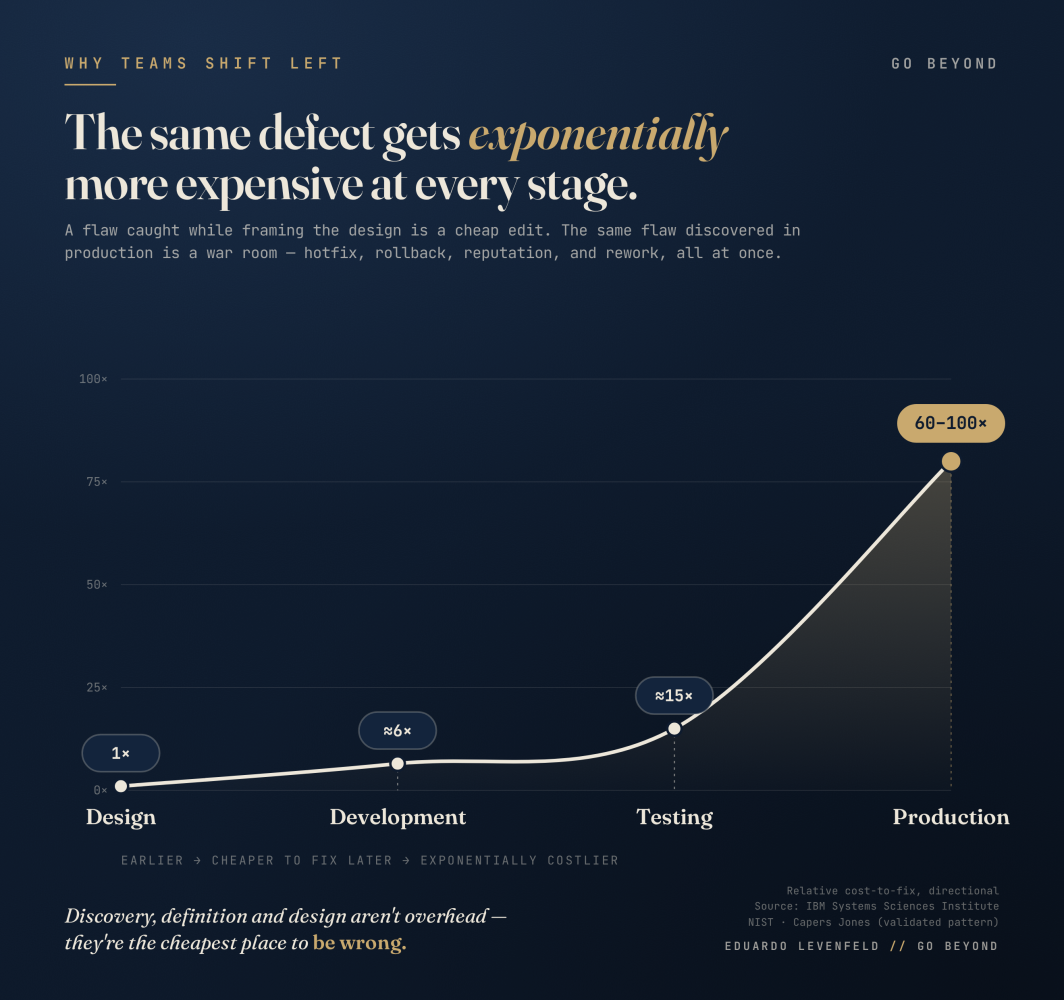
The lesson isn't "test more." It's that discovery, definition and design aren't overhead — they're the cheapest place in the entire cycle to be wrong.
07 · Launch — Ship it, then measure it
The most misunderstood stage of all. Teams treat launch as the finish line. It is the start line.
Modern launches are controlled, not ceremonial: feature flags to decouple deploy from release, canary and blue-green rollouts to limit blast radius, staged rollouts to catch problems on 1% before they hit 100%, and a genuine go-to-market motion so the product has a fighting chance of being found. A brilliant product with no distribution is a rounding error.
Universal example: a staged rollout where the first cohort is a controlled experiment, not a public bet.
Modern launches are controlled, not ceremonial: feature flags to decouple deploy from release, canary and blue-green rollouts to limit blast radius, staged rollouts to catch problems on 1% before they hit 100%, and a genuine go-to-market motion so the product has a fighting chance of being found. A brilliant product with no distribution is a rounding error.
- Frameworks: feature flags, canary / blue-green deployment, GTM strategy, AARRR ("pirate metrics": acquisition, activation, retention, revenue, referral).
- Tools: LaunchDarkly, GA4, Amplitude, Statuspage.
Universal example: a staged rollout where the first cohort is a controlled experiment, not a public bet.
08 · Growth — Learn, iterate, and know when to retire
Post-launch is where the loop closes and the product finally meets reality. The data starts talking — and this is exactly where the build trap bites.
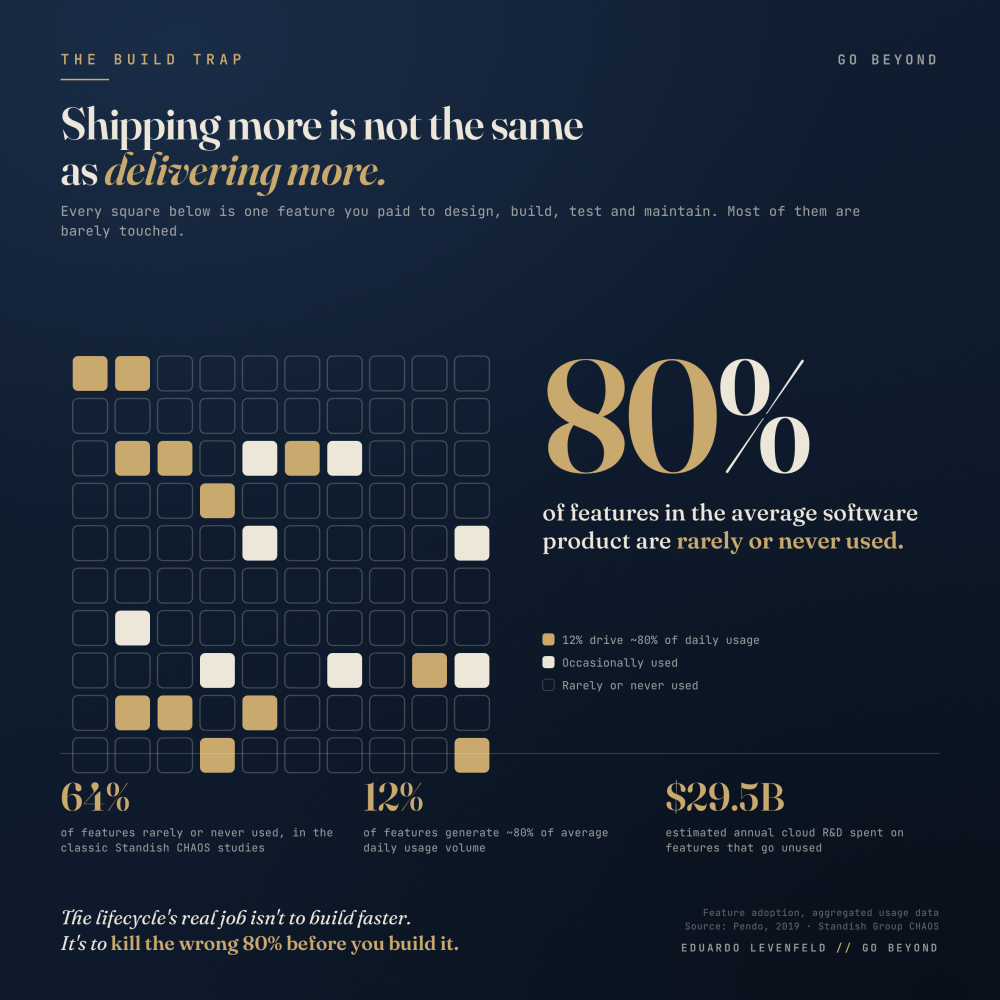
Pendo's analysis of anonymized usage found that around 80% of features in the average software product are rarely or never used, and just ~12% of features drive roughly 80% of daily usage — an estimated $29.5B of annual cloud R&D poured into features nobody touches. The older Standish CHAOS work put the "rarely or never used" figure near 64%. Different studies, same verdict: shipping more is not the same as delivering more.
So growth isn't only adding. It's measuring honestly, doubling down on the vital few, and having the discipline to sunset what doesn't earn its keep. And every insight you surface here becomes the seed of the next Discovery — which is the entire reason this is a loop and not a line.
Pendo's analysis of anonymized usage found that around 80% of features in the average software product are rarely or never used, and just ~12% of features drive roughly 80% of daily usage — an estimated $29.5B of annual cloud R&D poured into features nobody touches. The older Standish CHAOS work put the "rarely or never used" figure near 64%. Different studies, same verdict: shipping more is not the same as delivering more.
So growth isn't only adding. It's measuring honestly, doubling down on the vital few, and having the discipline to sunset what doesn't earn its keep. And every insight you surface here becomes the seed of the next Discovery — which is the entire reason this is a loop and not a line.
- Frameworks: the North Star Metric, growth loops, A/B testing, RICE again (now with real data behind the scores).
- Tools: Amplitude, Optimizely, Hotjar, Intercom.
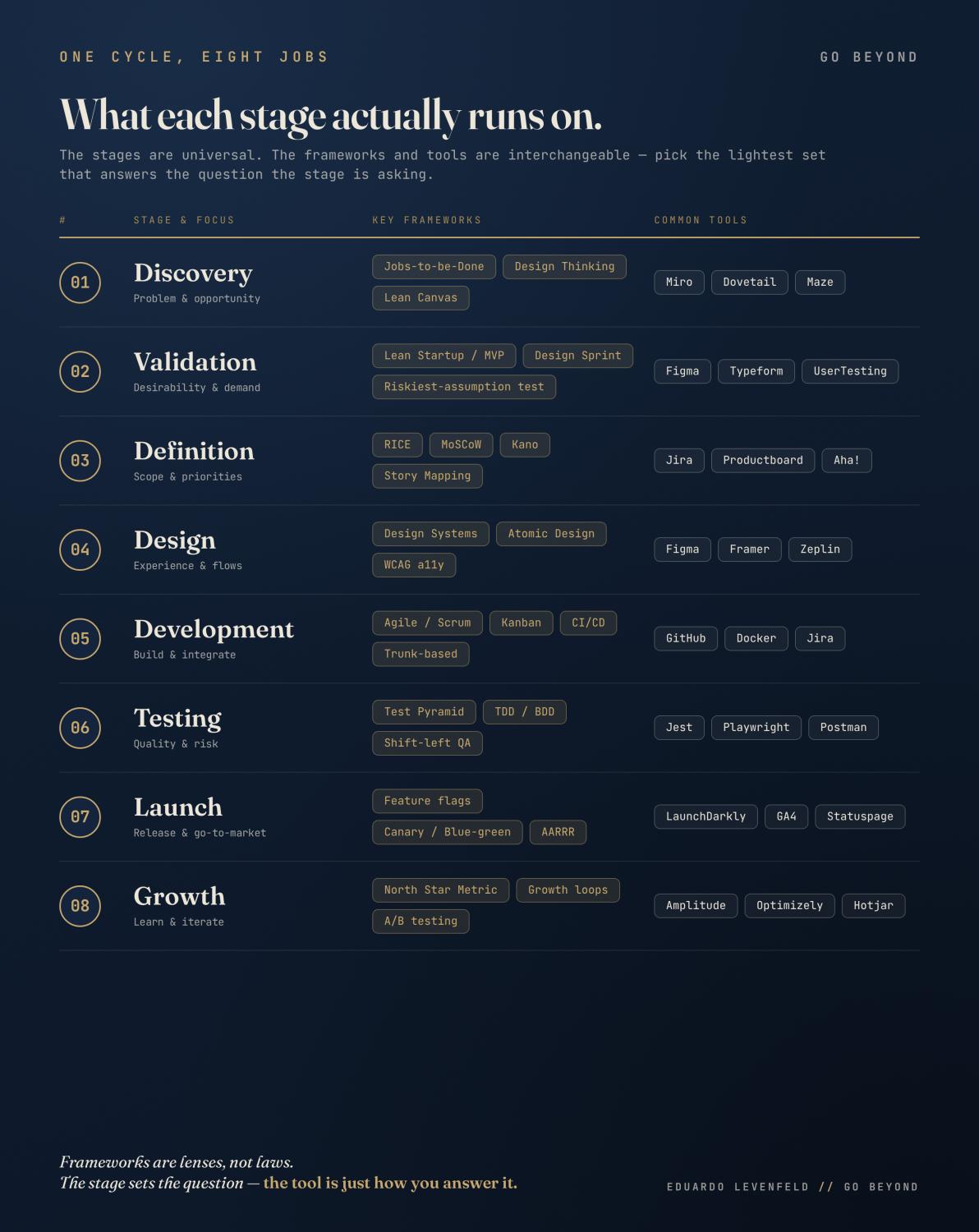
The stages are universal. The toolkit is negotiable.
One trap worth naming: teams fall in love with a framework and start serving the framework instead of the problem. Don't. The eight stages are stable across almost any digital product. The frameworks and tools inside them are interchangeable — pick the lightest set that answers the question the stage is actually asking.
The uncomfortable takeaway
The Product Development Life Cycle isn't a checklist you march through once. It's a loop you get better at spinning.
The teams that win aren't the ones that build fastest. They're the ones that learn fastest and kill wrong ideas cheapest — validating before they build, shifting quality left, and treating launch as the moment they finally get to learn rather than the moment they get to stop.
#ProductManagement #ProductDevelopment #DigitalProducts #Agile #ProductStrategy
The teams that win aren't the ones that build fastest. They're the ones that learn fastest and kill wrong ideas cheapest — validating before they build, shifting quality left, and treating launch as the moment they finally get to learn rather than the moment they get to stop.
#ProductManagement #ProductDevelopment #DigitalProducts #Agile #ProductStrategy