30.09.2026
Six North Stars for AI Transformation
Recently, I've been meeting a few times with a Dubai executive and entrepreneur, and talking about some well needed transformations, and the topic of AI was a top one.
In her words, this is the time to make it or break it.
She didn't ask me "which model?" or "which vendor?". She asked something quieter, wiser and much harder:
"How do we know we're doing this right?"
Most companies "doing AI transformation" right now look like a driver flooring the accelerator with the car still up on the jack:
Lots of noise. Wheels spinning fast. Going absolutely nowhere.
So instead of answering with a 40-slide model, like many of the fancy consulting boutiques, I did my best to come up with something simple, clear but yet useful.
I answered with a set of North Stars — a handful of things that, if you get them right, keep the whole thing pointed in the correct direction when everything else is noise.
These are 6 five stars, which I share with you know and hopefully it will be useful for you too.
But first, let's start with the uncomfortable baseline.
In her words, this is the time to make it or break it.
She didn't ask me "which model?" or "which vendor?". She asked something quieter, wiser and much harder:
"How do we know we're doing this right?"
Most companies "doing AI transformation" right now look like a driver flooring the accelerator with the car still up on the jack:
Lots of noise. Wheels spinning fast. Going absolutely nowhere.
So instead of answering with a 40-slide model, like many of the fancy consulting boutiques, I did my best to come up with something simple, clear but yet useful.
I answered with a set of North Stars — a handful of things that, if you get them right, keep the whole thing pointed in the correct direction when everything else is noise.
These are 6 five stars, which I share with you know and hopefully it will be useful for you too.
But first, let's start with the uncomfortable baseline.
The 95% Problem
MIT's Project NANDA studied 300 public AI deployments, interviewed 150 leaders, and surveyed hundreds of employees. Its 2025 report, The GenAI Divide: State of AI in Business 2025, landed like a cold shower: despite an estimated $30–40 billion in enterprise spending, 95% of organizations deploying generative AI saw zero measurable P&L return. Only about 5% created real value.
Read that twice. Thirty to forty billion dollars. Ninety-five percent of it, invisible on the P&L.
The reflex is to blame the technology — the models are immature, the regulation is unclear, the tooling isn't ready yet. The data refuses to cooperate. The winners and the losers were using the same models. MIT's own diagnosis was that the failure was almost never technical. It was organizational. A learning gap. A workflow gap. A design gap.
Here's the part I keep coming back to, and regular readers already know my position on it:
Read that twice. Thirty to forty billion dollars. Ninety-five percent of it, invisible on the P&L.
The reflex is to blame the technology — the models are immature, the regulation is unclear, the tooling isn't ready yet. The data refuses to cooperate. The winners and the losers were using the same models. MIT's own diagnosis was that the failure was almost never technical. It was organizational. A learning gap. A workflow gap. A design gap.
Here's the part I keep coming back to, and regular readers already know my position on it:
AI is excellent at the symptom layer — speed, cost, throughput. It is close to useless at the root-cause layer if you point it there carelessly.
Most "AI transformations" are efficiency theater bolted onto broken foundations. Let me be precise, because I'm not anti-AI. I'm anti-theater. The North Stars exist to drag the conversation back down to the foundations — where transformations are actually won or lost.
Six of them.
Six of them.
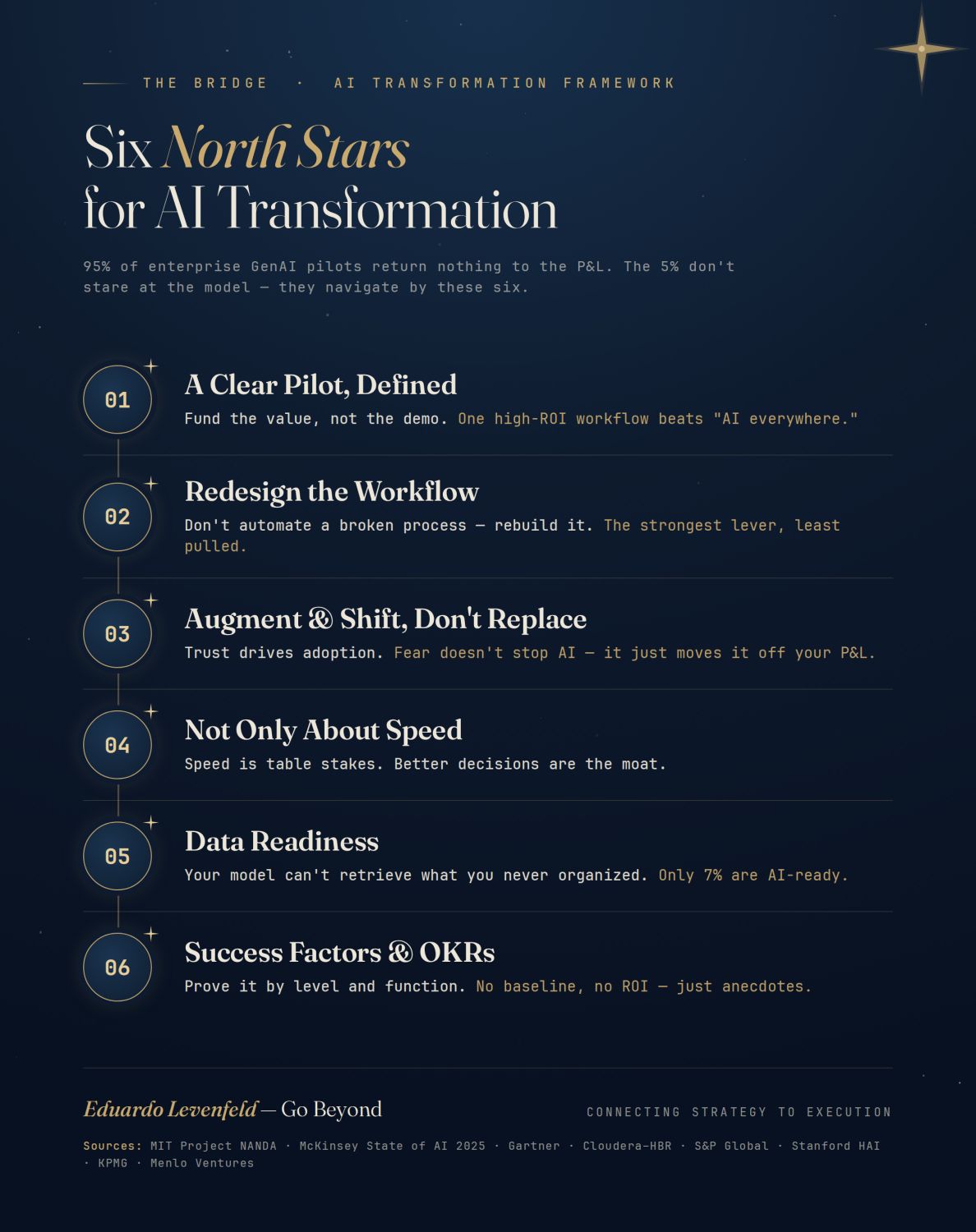
North Star 1 — A Clear Pilot, Defined
Trying to transform everything at once is a recipe for failure. The companies that cross MIT's GenAI Divide do the opposite of "AI everywhere." They pick one painful, high-value workflow, execute it well, and partner smartly. Some of the fastest-scaling firms in the study went from zero to real revenue by solving a single problem with precision.
Two data points make this actionable.
First, choose the pilot by ROI, not by visibility. MIT found more than half of GenAI budgets flowing into sales and marketing — the glamorous, board-facing use cases — while the strongest returns sat quietly in back-office and operations. Companies were funding the demo, not the value.
Second, buy the platform and build the differentiation. In the same study, externally sourced or partner-led deployments reached production about 67% of the time, versus roughly 33% for internal builds — a 2x gap. Menlo Ventures' 2025 survey shows the market already caught on: purchased use cases jumped from 53% to 76% of deployments in a single year. Going solo, especially in a regulated sector, is just the expensive way to learn this lesson.
Fund the value, not the demo.
Two data points make this actionable.
First, choose the pilot by ROI, not by visibility. MIT found more than half of GenAI budgets flowing into sales and marketing — the glamorous, board-facing use cases — while the strongest returns sat quietly in back-office and operations. Companies were funding the demo, not the value.
Second, buy the platform and build the differentiation. In the same study, externally sourced or partner-led deployments reached production about 67% of the time, versus roughly 33% for internal builds — a 2x gap. Menlo Ventures' 2025 survey shows the market already caught on: purchased use cases jumped from 53% to 76% of deployments in a single year. Going solo, especially in a regulated sector, is just the expensive way to learn this lesson.
Fund the value, not the demo.
North Star 2 — Redesign the Workflow, Don't Automate It
This is the star I nearly left out in Dubai. It might be the most important one here.
Once you've chosen the pilot, the real question isn't which tool. It's whether you're willing to rebuild the process around the tool — or whether you're just going to decorate the process you already have.
The evidence on this is the strongest single finding in the whole field. McKinsey tested roughly 25 organizational factors against financial impact. Of all of them, fundamental workflow redesign had the strongest correlation with EBIT — and high performers were about 3x more likely to have done it. The catch? Only around 21% of adopters had actually redesigned any workflow.
Read that again. The most powerful lever is also the least-pulled one. That gap is the opportunity.
MIT describes the same divide from the other side: the 95% bolt generic tools onto existing processes and land in what the report calls high-adoption, low-transformation mode — slick in the demo, brittle in the workflow. The 5% let the process itself change.
So let me name it plainly, because most decks won't:
Automating a broken process doesn't fix it. It just lets you fail faster — and at scale.
Don't pave the cow path. If the pilot is worth doing, the workflow underneath it is worth rebuilding.
Once you've chosen the pilot, the real question isn't which tool. It's whether you're willing to rebuild the process around the tool — or whether you're just going to decorate the process you already have.
The evidence on this is the strongest single finding in the whole field. McKinsey tested roughly 25 organizational factors against financial impact. Of all of them, fundamental workflow redesign had the strongest correlation with EBIT — and high performers were about 3x more likely to have done it. The catch? Only around 21% of adopters had actually redesigned any workflow.
Read that again. The most powerful lever is also the least-pulled one. That gap is the opportunity.
MIT describes the same divide from the other side: the 95% bolt generic tools onto existing processes and land in what the report calls high-adoption, low-transformation mode — slick in the demo, brittle in the workflow. The 5% let the process itself change.
So let me name it plainly, because most decks won't:
Automating a broken process doesn't fix it. It just lets you fail faster — and at scale.
Don't pave the cow path. If the pilot is worth doing, the workflow underneath it is worth rebuilding.
North Star 3 — Augmenting and Shifting, Not Replacing
Trust is fundamental, and the mindset that builds it is augmenting and shifting work — not replacing people. This isn't a feel-good line. It's adoption economics.
Look at what employees actually feel. A KPMG study with the University of Melbourne — over 48,000 people across 47 countries — found 82% wary of AI-driven misinformation and 82% afraid of deskilling. Stanford's 2026 AI Index reports 52% of people now say AI makes them nervous, up year over year. The APA's Work in America survey found 41% worry AI will make part or all of their job obsolete.
Now, here's the part nobody likes to say out loud. Frightened people don't adopt. They route around you. That's why MIT documented a "shadow AI economy" where roughly 90% of workers use personal AI tools for work even when the official pilot has died in a boardroom.
Fear doesn't stop AI adoption. It just moves it off your governance and off your P&L.
The counter-move is visible in the leaders. EY finds many organizations reinvesting productivity gains into R&D, cybersecurity, and reskilling instead of cutting headcount — and warns that the real risk isn't job loss, it's loss of purpose. HBR argued in 2026 that firms choosing augmentation over pure automation may simply win the long game. And Gallup's number is worth taping to a wall: a highly engaged workforce runs about 23% more profitable.
Augment and shift. It's the slower-looking path that compounds.
Look at what employees actually feel. A KPMG study with the University of Melbourne — over 48,000 people across 47 countries — found 82% wary of AI-driven misinformation and 82% afraid of deskilling. Stanford's 2026 AI Index reports 52% of people now say AI makes them nervous, up year over year. The APA's Work in America survey found 41% worry AI will make part or all of their job obsolete.
Now, here's the part nobody likes to say out loud. Frightened people don't adopt. They route around you. That's why MIT documented a "shadow AI economy" where roughly 90% of workers use personal AI tools for work even when the official pilot has died in a boardroom.
Fear doesn't stop AI adoption. It just moves it off your governance and off your P&L.
The counter-move is visible in the leaders. EY finds many organizations reinvesting productivity gains into R&D, cybersecurity, and reskilling instead of cutting headcount — and warns that the real risk isn't job loss, it's loss of purpose. HBR argued in 2026 that firms choosing augmentation over pure automation may simply win the long game. And Gallup's number is worth taping to a wall: a highly engaged workforce runs about 23% more profitable.
Augment and shift. It's the slower-looking path that compounds.
North Star 4 — Not Only About Speed
Still on mindset. The goal is not to make everything faster. It's to improve the quality of the work and the flow of it — and to tie that to real outcomes.
The market is repricing "speed" as I write this. Futurum Group's 2026 survey of 830 enterprise decision-makers found productivity gains collapsing as the top AI success metric, while hard P&L accountability nearly doubled. Their analyst put it bluntly: teams selling "save four hours per week" are entering a losing conversation. IBM makes the same call with its split between hard ROI (revenue, cost) and soft ROI (decision quality, judgment) — and the discipline is never letting soft mask the absence of hard.
McKinsey adds the strategic version: 80% of companies set efficiency as their AI objective, but the high performers add growth and innovation — and those are the ones capturing value.
This is exactly the nuance I raised in Dubai. From a developer, sure, expect optimized time with an AI companion. But from an executive? "Faster" is almost the wrong metric. What you want is better decisions, more decisiveness, sharper communication. Same technology. Completely different definition of success.
Speed is table stakes. Better decisions are the moat.
The market is repricing "speed" as I write this. Futurum Group's 2026 survey of 830 enterprise decision-makers found productivity gains collapsing as the top AI success metric, while hard P&L accountability nearly doubled. Their analyst put it bluntly: teams selling "save four hours per week" are entering a losing conversation. IBM makes the same call with its split between hard ROI (revenue, cost) and soft ROI (decision quality, judgment) — and the discipline is never letting soft mask the absence of hard.
McKinsey adds the strategic version: 80% of companies set efficiency as their AI objective, but the high performers add growth and innovation — and those are the ones capturing value.
This is exactly the nuance I raised in Dubai. From a developer, sure, expect optimized time with an AI companion. But from an executive? "Faster" is almost the wrong metric. What you want is better decisions, more decisiveness, sharper communication. Same technology. Completely different definition of success.
Speed is table stakes. Better decisions are the moat.
North Star 5 — Data Readiness
Data is primordial — and this is where most transformations quietly die.
Ask yourself something concrete: how exactly would you speed up and improve the work of a sales rep if there's no structured data on client movements and product knowledge available to the model? You can't. The pilot can't retrieve what the company never bothered to organize.
The numbers are brutal and consistent:
Data readiness isn't a workstream you get to later. It's the precondition. Every other star on this list quietly assumes it.
Your model can't retrieve what your company never bothered to organize.
Ask yourself something concrete: how exactly would you speed up and improve the work of a sales rep if there's no structured data on client movements and product knowledge available to the model? You can't. The pilot can't retrieve what the company never bothered to organize.
The numbers are brutal and consistent:
- Cloudera and Harvard Business Review Analytic Services (2026): only 7% of enterprises say their data is completely ready for AI. 27% admit it's barely ready or not at all. 73% say they should prioritize data quality more than they do.
- Gartner: 63% of organizations lack — or aren't sure they have — the data-management practices AI requires. Gartner also predicts 60% of AI projects unsupported by AI-ready data will be abandoned through 2026.
- McKinsey: data readiness is a key reason only 7% of companies have fully scaled AI, with teams burning 60–70% of project time just on data prep.
- S&P Global: 42% of companies abandoned the majority of their AI initiatives before production — up from 17% a year earlier.
Data readiness isn't a workstream you get to later. It's the precondition. Every other star on this list quietly assumes it.
Your model can't retrieve what your company never bothered to organize.
North Star 6 — Success Factors and OKRs (by level, not generically)
You need success factors — but not generic ones. By level and by function. From a developer, optimized time. From an executive, decision quality, decisiveness, communication. One enterprise-wide "AI productivity" KPI flattens all of that into noise.
This is the star that makes the other five provable, and the research says it's the one most often skipped. The Return on AI Institute's 2026 survey of over 1,000 executives found a direct correlation between measurement sophistication and value actually captured. The most common failure? The missing-baseline problem — deploying AI without documenting the "before," so every ROI claim becomes an anecdote. McKinsey reaches the same verdict from the top down: scaling without metrics is exactly where programs stall.
If you can't say what the number was, you can't prove what AI did.
OKRs, defined per function and anchored to a baseline, are what separate a transformation from a spending spree.
This is the star that makes the other five provable, and the research says it's the one most often skipped. The Return on AI Institute's 2026 survey of over 1,000 executives found a direct correlation between measurement sophistication and value actually captured. The most common failure? The missing-baseline problem — deploying AI without documenting the "before," so every ROI claim becomes an anecdote. McKinsey reaches the same verdict from the top down: scaling without metrics is exactly where programs stall.
If you can't say what the number was, you can't prove what AI did.
OKRs, defined per function and anchored to a baseline, are what separate a transformation from a spending spree.
The stars form a loop, not a checklist
These six aren't a sequence you complete and file away. They're a system that has to stay in balance. A clear pilot you refuse to redesign around is just a faster version of the old problem. Augmentation without OKRs drifts into feel-good adoption with no P&L. Chasing speed without a quality metric is the efficiency theater MIT measured at 95% failure. And all of it collapses without data readiness underneath.
Pull one star out of alignment and the others quietly lose their bearing.
That's why the 5% aren't luckier or better-funded — the MIT data is explicit that budget wasn't the differentiator. They're simply navigating by these stars while everyone else stares at the model.
Pull one star out of alignment and the others quietly lose their bearing.
That's why the 5% aren't luckier or better-funded — the MIT data is explicit that budget wasn't the differentiator. They're simply navigating by these stars while everyone else stares at the model.
The stars point the ship. Governance sails it.
One honest caveat, because I'd rather say it here than have you discover it in production. These six set your direction. They don't, on their own, tell you who owns it or how you keep it safe. That's the operating layer underneath — and for a C-suite audience, especially in a regulated sector, it isn't optional.
Two findings to hold onto. McKinsey reports that 51% of firms have already had an AI-related incident, and that executive-level oversight of AI governance correlates with financial impact, particularly at larger companies. Governance isn't a brake on value; it's associated with more of it. And MIT found that the organizations crossing the divide decentralize with clear accountability — empowering the line managers who do the work rather than routing everything through a central lab.
So lay two questions over all six stars: who is accountable for each one, and where is the human in the loop when it matters?
Two findings to hold onto. McKinsey reports that 51% of firms have already had an AI-related incident, and that executive-level oversight of AI governance correlates with financial impact, particularly at larger companies. Governance isn't a brake on value; it's associated with more of it. And MIT found that the organizations crossing the divide decentralize with clear accountability — empowering the line managers who do the work rather than routing everything through a central lab.
So lay two questions over all six stars: who is accountable for each one, and where is the human in the loop when it matters?
Direction without ownership is a wish. Ownership without governance is a risk you haven't priced yet.
A Final Thought
I'm not anti-AI. I'm anti-theater. And most of what gets called "AI transformation" today is theater with a big budget and a beautiful dashboard.
AI will happily optimize the symptom layer for you, at machine speed. Whether it ever reaches the root causes — unclear priorities, undesigned workflows, low trust, unmeasured quality, ungoverned data — was never a technical question. It's a leadership one.
So before your next pilot, one honest question:
Which of these six North Stars is your organization actually navigating by — and which are you quietly assuming will take care of themselves?
AI will happily optimize the symptom layer for you, at machine speed. Whether it ever reaches the root causes — unclear priorities, undesigned workflows, low trust, unmeasured quality, ungoverned data — was never a technical question. It's a leadership one.
So before your next pilot, one honest question:
Which of these six North Stars is your organization actually navigating by — and which are you quietly assuming will take care of themselves?
Sources
- MIT Project NANDA — The GenAI Divide: State of AI in Business 2025 — 95% of GenAI deployments with zero measurable P&L return; buy-vs-build gap (~67% vs ~33%); budget skew to sales/marketing; shadow-AI economy; high-adoption/low-transformation; decentralized accountability.
- McKinsey — The State of AI 2025 (QuantumBlack) — workflow redesign as the strongest EBIT correlation (~3x for high performers; only ~21% had redesigned); efficiency vs growth objectives; 51% AI-incident rate; executive oversight and EBIT; "scaling without metrics stalls."
- McKinsey Technology — AI Data Readiness: The Key to Scaling Impact (2026) — only 7% have fully scaled AI; 60–70% of project time on data preparation.
- Cloudera & Harvard Business Review Analytic Services — Taming the Complexity of AI Data Readiness (2026) — 7% completely AI-ready; 27% not ready; 73% under-prioritize data quality.
- Gartner — 63% lack or are unsure of AI-ready data-management practices; 60% of AI projects without AI-ready data to be abandoned through 2026.
- S&P Global Market Intelligence (2025) — 42% abandoning the majority of AI initiatives before production, up from 17%.
- KPMG & University of Melbourne — Trust in AI (48,000+ respondents, 47 countries) — 82% wary of AI misinformation; 82% fear deskilling.
- Stanford HAI — AI Index Report 2026 — 59% say benefits outweigh drawbacks; 52% say AI makes them nervous (rising).
- American Psychological Association — Work in America (2024) — 41% worry AI will make part or all of their job obsolete.
- EY — AI Pulse Survey / Redesigning Work Around Human Skills — productivity gains reinvested over headcount cuts; "loss of purpose" as the real risk.
- Harvard Business Review (2026) — the long-run case for augmentation over automation.
- Gallup (2025) — highly engaged workforces ~23% more profitable.
- Futurum Group — 2026 Enterprise Software Decision-Maker Survey (830 respondents) — productivity fading as a top AI metric; hard P&L accountability rising.
- IBM — the hard-ROI vs soft-ROI (decision quality) distinction.
- Return on AI Institute (2026) — measurement sophistication correlated with value captured; the "missing-baseline" problem.
- Menlo Ventures — State of Generative AI in the Enterprise 2025 — purchased AI use cases rising from 53% to 76% year over year.